
 Air Despatch was pioneered during the First World War to supply the besieged British Garrison at Kut al Amara in present day Iraq and came into its own during the Second World War in support of military operations in Southeast Asia and the ultimately doomed Operation Market Garden. Yet as much as Aerial Resupply serves a military role, it also provides a means by which humanitarian aid can be delivered swiftly and efficiently to those in need during times of crisis, whether because of drought and famine, or because of the sheer remoteness of the location, as seen during the drops over Tristain de Cunha. Below are just a few of the missions undertaken since 1945.
- Operation Manna (April – May 1945)
Perhaps the first ever major humanitarian air drop conducted by British Forces was Op Manna, the dropping of food into Nazi-occupied Netherlands in a remarkable show of common humanity during the last days of the Second World War. At the time the Netherlands was experiencing a terrible famine caused by war shortages and harsh winters, and by May 1945 over 20,000 people were believed to have died of starvation. A truce was therefore agreed between the Allies and German commanders to allow Allied aircraft to fly unopposed daylight sorties to drop supplies to the Dutch population. Over the course of 11 days Allied forces dropped over 18,000 tonnes of supplies, staving off the worst of the famine until the war’s end, when supplies could start readily flowing into the Netherlands again.
- Berlin Airlift (June 1948 – May 1949)
Royal Army Service Corps Air Despatchers played a vital role in the Berlin Airlift, ensuring that the 2.5 million residents of West Berlin were kept fed as Soviet forces cut off land and river access to the city in attempt to force the Western Allies to retreat. Over the course of 12 months, 395,509 tons of food and other supplies were flown in via three narrow air corridors by mainly British and American aircraft.

- Kenyan Famine (1961)
Some of the earliest peacetime efforts at humanitarian air drops directly involving airborne British Army logisticians were conducted by members of 16 Company (Air Despatch) Royal Army Service Corps during the 1961 Kenyan Famine. Operating from the Royal Air Force’s rather ungainly looking Blackburn Beverley transport aircraft, 16 Coy distributed over 181 tonnes of supplies across Kenya to help alleviate the crisis.
- Operation Bushel (1984)
The 1983-85 Ethiopian famine, caused by a combination of droughts and a long running civil war, affected over 8 million people and claimed the lives of between 300,000–1,200,000. Their plight was highlighted in October 1984 by Michael Buerk in a landmark BBC News report that shocked the world prompting the British Government to authorise the deployment of UK Armed Forces personnel to help provide aid.
Op Bushel saw Air Despatchers of 47 AD Squadron Royal Corps of Transport set up a base of operations at Addis Ababa Airport from where they conducted over 1,198 air-landing sorties and 954 air-dropping sorties, delivering a total of 32,668 tonnes of grain across Ethiopia from the RAF’s C-130 Hercules. When not in the air, members of the Squadron also helped established a Children’s Village for those who had been orphaned by the crisis.
- Operation Shader (2014)
2014 saw members of 47 Squadron RLC conducting aerial supply drops over Mount Sinjar in Iraq where tens of thousands of members of the Yazidi minority were seeking desperate refuge in the face of genocide at the hands of Islamic State. Over the course of seven sorties, supplies, medical equipment and other necessaries were dropped over the active conflict zone.
More Recent Humanitarian Missions
47 Squadron once again made the news in 2024 by joining humanitarian air drop missions over Gaza, dropping over 1,500 tonnes of material to those caught amid the fighting which had caused a mass refugee crisis.
And of course, May 2026 saw the spectacular operation in which personnel from 47 Squadron RLC worked with colleagues from the Royal Air Force and 16 Air Assault Brigade to pack and then despatch 2,500 Kg of Oxygen and medical supplies to the remote British Overseas Territory of Tristan de Cunha in the Mid Atlantic, 1,500 miles from the nearest major land mass, in response to the Hantavirus outbreak.
The initial pass of the island saw paratroopers and medics jump from 7,000 feet onto the rocky island below, after which they set up a drop zone in a vegetable patch onto which the Air Despatchers could drop the supplies on four pallets in a lower altitude pass. Conditions were challenging, as expected from an island in the middle of the southern Atlantic, but the skills and expertise of the Air Despatchers and their RAF pilots saw the mission conducted safely and successfully, building on a long history of helping those in need of which the British Army and the RLC can be very proud.
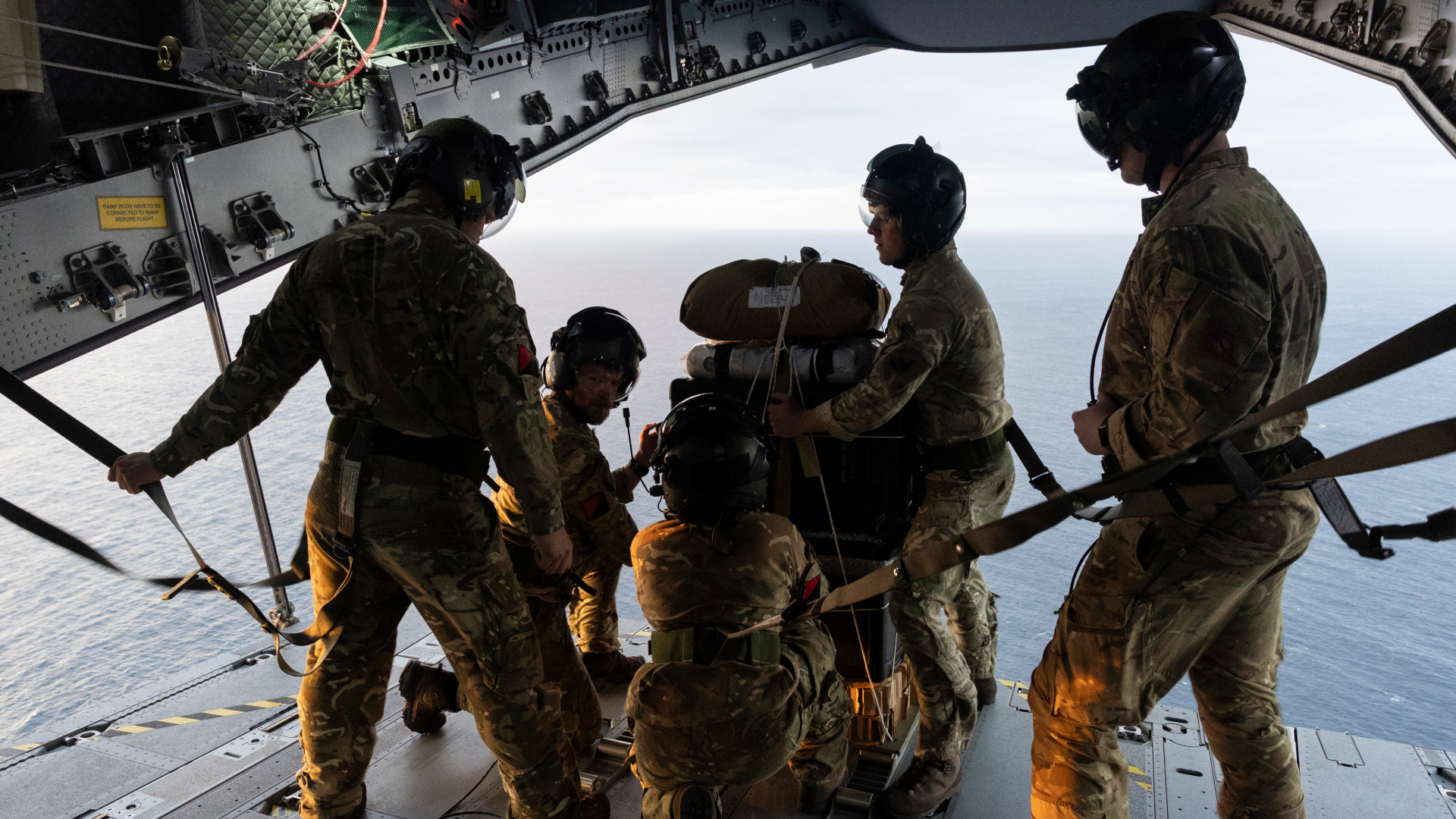
Pictured here are RLC Air Despatchers at the edge of the ramp waiting to be above the drop zone to dispatch some one of the palletes of medical supplies.
On 9th May 2026, an Atlas A400M took off from Ascension Island, supported by a Voyager to transit down to Tristan da Cunha where it did airdrops of troops and supplies to help personnel on the island.
There were 6 Paratroopers from 16 Air Assault Brigade who jumped, two in tandem with a Nurse and Doctor to provide medical support to people residing on Tristan da Cunha. Along side the paratroopers, the A400M also dropped medical supplies.
Bottom image: UK Ministry of Defence © Crown Copyright 2026


Leave A Comment