
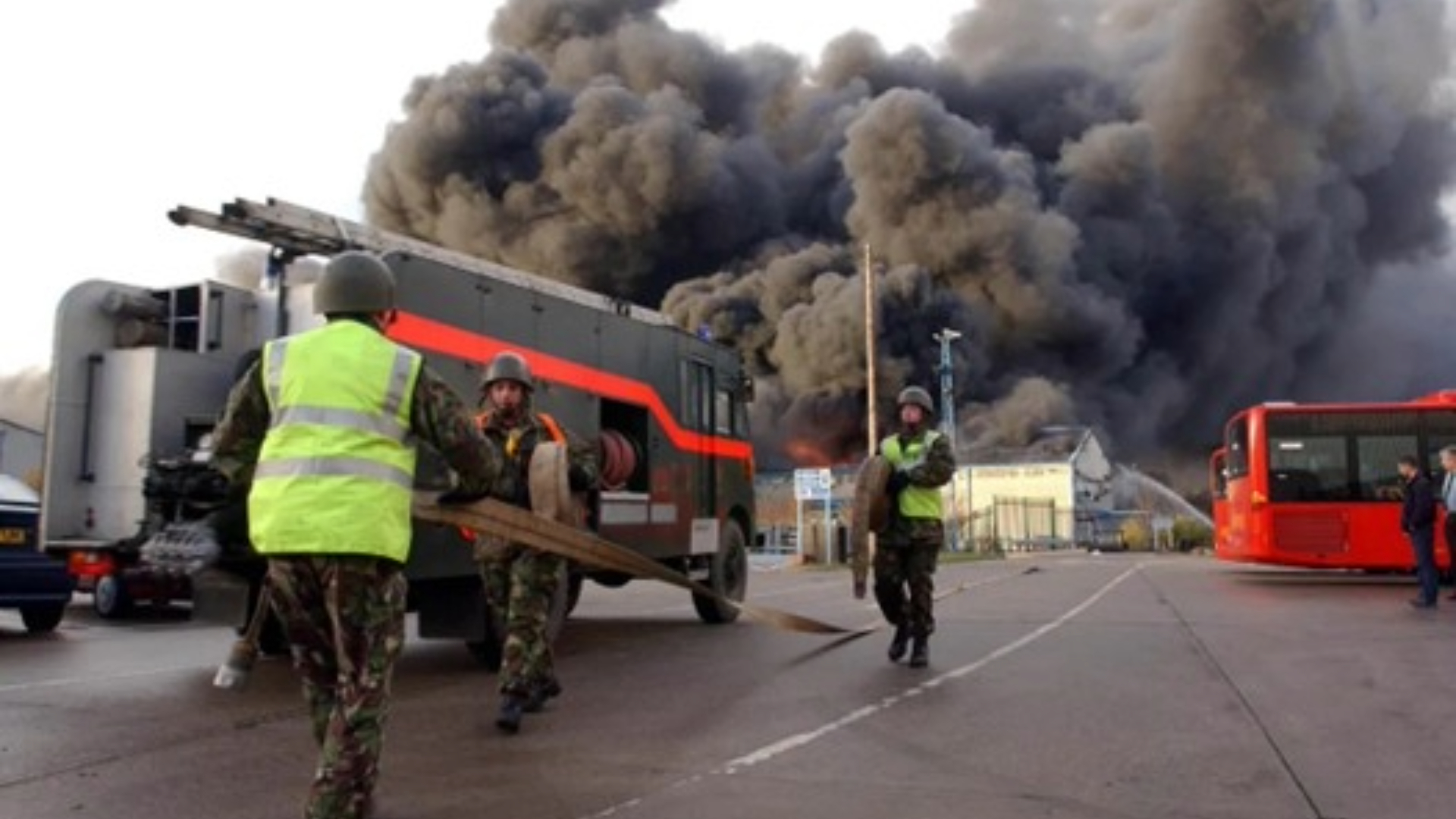
The British Armed Forces’ job is, first and foremost, to protect the UK and the lives of its citizens. Naturally enough, this typically involves engaging in military combat against those who would seek to do harm or disrupt the smooth running of the country. However, the Armed Forces can also be called upon to aid the civilian authorities in times of crisis, such as a natural disaster or terrorist attack. Key to the subject of this post is the content of the Emergency Powers Act of 1964. Section 2 of this Act of Parliament states that military personnel are permitted “temporary employment in agricultural work or in other work, being urgent work of national importance”.
When in November 2002 British firefighters, caught in a dispute over their salaries, took the drastic step to suspend their vital work, the Armed Forces were called into action to maintain the UK’s emergency response capabilities, in what was named Operation Fresco.

3 CS Regt RLC soldiers extinguish chimney fire in Staffordshire (Copyright Soldier Magazine 2003)
The RLC’s involvement
The Royal Logistics Corps formed part of the response to the strike action, with its personnel mainly assuming responsibility for the Home Counties region of the operation, though an RLC detachment was also based in Staffordshire. The headquarters for this region was in Aldershot, Hampshire, though fire cover for Hampshire itself was principally provided by the Royal Navy.
Soldiers from the RLC were involved in responding to many varied incidents, including such things as chimney fires, as seen in the image to the right.
Why were firefighters striking?
As with most instances of industrial action, the issues involved were complex. The Fire Brigades Union (FBU) was demanding a significant wage rise of 40% for its members. The Government rejected these demands on the grounds that such a wage increase would result in similar requests from other public sector workers, leading to increased taxation. The FBU argued that their present pay scheme, itself the result of nationwide strike action in 1977, was outdated. A review commissioned by the Government recommended a two stage pay increase totalling a rise of 11%. This was rejected by the unions, and strike action began on November 13th 2002.
What is a Green Goddess?
During the industrial action, the vehicles belonging to the civilian fire brigade were mostly out of action, though some were later able to be brought into service by military personnel. The military operation therefore mostly relied on the now famous “Green Goddess” fire engine to provide its firefighting capabilities.
The Green Goddess, officially known as the Bedford RLHZ Self Propelled Pump, has its roots in the tension of the early years of the Cold War. It was believed that any potential nuclear attack on the UK would cause so many fires that the regular fire brigade would be overwhelmed, if indeed it could still operate at all. As a result, in the 1950s the Government sought to re-equip the Auxiliary Fire Service, which had been formed in 1938. A key part of this was the production of a large stock of basic fire engines, based on the military’s Bedford RL truck.

A Green Goddess fire engine (Copyright johnbrown4x4 2025).

A Goddess crew attend an incident in Northern Ireland, showing both the yellow livery used in the region and the mesh placed over the windows to protect the crews from projectiles (Copyright Soldier Magazine 2002).
Interestingly, actual firefighting was not intended to be the Green Goddess’ main responsibility. They were predominantly meant to function as mobile water pumps, transferring huge quantities of water into nuclear hit cities. Nevertheless, they would form the backbone of the Forces’ response to the 2002-2003 strikes, with 827 Goddesses being called to cover around 3,000 regular vehicles. In Northern Ireland, the vehicles were painted into a yellow livery to avoid potentially controversial associations with the British Army.
Equipment and capabilities
Understandably, there were questions over the ability of these half century old machines to cope with 21st century work. With regards to speed, while not as fast as modern fire appliances, the Goddess was still capable of reaching a maximum speed of 50mph. It carried 1600 feet of hose reel and could use foam instead of water where necessary. However, the vehicle’s water pump was only capable of working at a low pressure. This meant that instead of the dense spray produced by modern engines, the Goddess’ water jet produced an effect more akin to a garden hose.
There were other shortcomings in the Goddess’ arsenal. They were only equipped with a single 35ft ladder rather than the five 45ft ladders carried by modern red engines. They also carried no radio, meaning a police escort was required when responding to emergency calls.

Soldiers training with a Goddess hose (Crown Copyright 2003)

Royal Naval BART (top) and Royal Air Force REST (bottom) vehicles (Crown Copyright 2003)
BARTs and RESTs
The organisers of Op Fresco were all too aware of the variety of emergencies that fire brigades respond to, and that all their personnel could never be trained at such short notice to face them all. If there was a need to rescue people from such things as burning buildings or crashed cars, rather than simply extinguishing a fire, more specialised help would be needed. Thus, there was a need for the use of Breathing Apparatus Rescue Teams (BARTs) or Rescue Equipment Support Teams (RESTs). These small teams were made up of personnel from the Royal Navy and RAF who had been trained as specialist firefighters for their military branches. Teams would respond in a light truck hastily converted into an emergency vehicle by the addition of a blue light and fluorescent markings, giving their vehicles an undeniably makeshift appearance. Equally undeniable was the fact that coverage was spread fairly thinly, with only 331 BARTs and 59 RESTs available for the whole of the UK. The two types of team would carry similar equipment, with RESTs additionally being equipped with a thermal imaging camera and resources to deal with incidents involving hazardous materials.
A successful operation
In total, 18,600 Armed Forces personnel took part in the operation. From the 22nd to the 30th November, 12,160 incidents were attended by military personnel. The emergency response was directed from Joint Operational Control Centres (JOCCs), located in police communication facilities and jointly staffed by police and Armed Forces staff. Calls that were placed to the JOCCs were assessed by a working fire brigade officer, who determined what response was needed. At the same time, the nearest available police vehicle would be directed to attend the scene and confirm the situation. This allowed the limited Green Goddess, BART and REST resources to be allocated to where they were most needed.
All in all, the UK’s citizens were largely able to continue with their lives uninterrupted while the dispute was resolved. The industrial and transportation landscapes were largely not affected. The FBU ultimately accepted a pay rise of 16% over 3 years, and such widespread strike action has not occurred again. The UK’s Green Goddess fleet has now been decommissioned, and the vehicles sold off. Some were purchased for use in other countries, mostly in Africa, and others went to various museums and private collections.
If these events of over twenty years ago have any legacy, it is to remind the public of the essential role the Armed Forces are forever ready to play in safeguarding us all, whatever the circumstances may be, and however trying they may become.
Read part 1 of George’s exploration of firefighting in the British Army here.
George Matthews, RLC Museum Volunteer


This is a fascinating look at how the UK government responded to the 2002–03 firefighters’ strike by deploying military personnel and vintage “Green Goddess” fire engines to provide emergency cover under Operation Fresco. It shows the complexity of balancing labour disputes, public safety, and operational readiness, and highlights how much this event shaped public and union perceptions of military involvement in civil emergencies.
Green Godesses like all military vehicles had funny names. The Godess was known to the troops as “Pump, water, mediocre performance undrivable/unbanned”. These vehicles were never any good at supplying water under any usable pressure because as you say they were never originally intended for that purpose.
As a driver you wrestled with no power steering, no air-conditioning (LOL) but more importantly no baffles in the water tank. This meant if you applied the brakes at speed, the vehicle stopped, and then the unbaffled water would strike the bulkhead launching along the road. Most drivers would carry spare underwear just in case !!