
Military activity, whichever service one may find themselves in, always carries a certain level of danger to life. Explosive materials, if handled improperly, can kill or seriously injure in a split second. Enemy munitions also trigger serious fires after serving their initial destructive purpose. The ability to contain fires is therefore of paramount importance for all military facilities. The history of dedicated firefighting personnel in the British Armed Forces is complex but is intrinsically linked to the story of the RLC and the forming corps that preceded it.

An Edwardian firefighter’s uniform. The jacket was based on a civilian firefighter’s uniform but featured Army accoutrements such as NCO rank insignia and army General Service buttons. It is pleated around the skirt to allow for both protection and flexibility.
Pioneer Corps – 1941 – 1946
Before the Second World War, the Army did not have a dedicated branch of personnel for firefighting duties, though various garrisons, including those at Aldershot and Bordon, maintained their own fire brigades. These were staffed by NCOs seconded from line regiments and supported by civilians. The fire engines of this era were horse drawn, with horses and drivers being supplied by the Royal Army Service Corps following its formation in 1888. An Edwardian firefighter’s uniform is part of the RLC Museum’s collection.
In 1941, the first dedicated Army-wide firefighting force was established. This force, named the Army Fire Service, fell under the jurisdiction of the Pioneer Corps, responsible for light engineering tasks. The men of this force served in most of the war’s theatres of operation and undertook many tasks, including the crewing of firefighting boats. Though their role was specialist, all members undertook infantry training, and indeed often had to engage in combat with the enemy.
Army Fire Service personnel also assisted the civilian National Fire Service in firefighting efforts during the Blitz.
Army Fire Service – 1946 – 1991
The firefighting branch of the Pioneer Corps was disbanded at the end of the War. The Army Fire Service became part of the Royal Army Service Corps, then in 1961 responsibility transferred to the Royal Army Ordnance Corps. Following its transferal to the RAOC, the AFS became a civilian staffed unit.
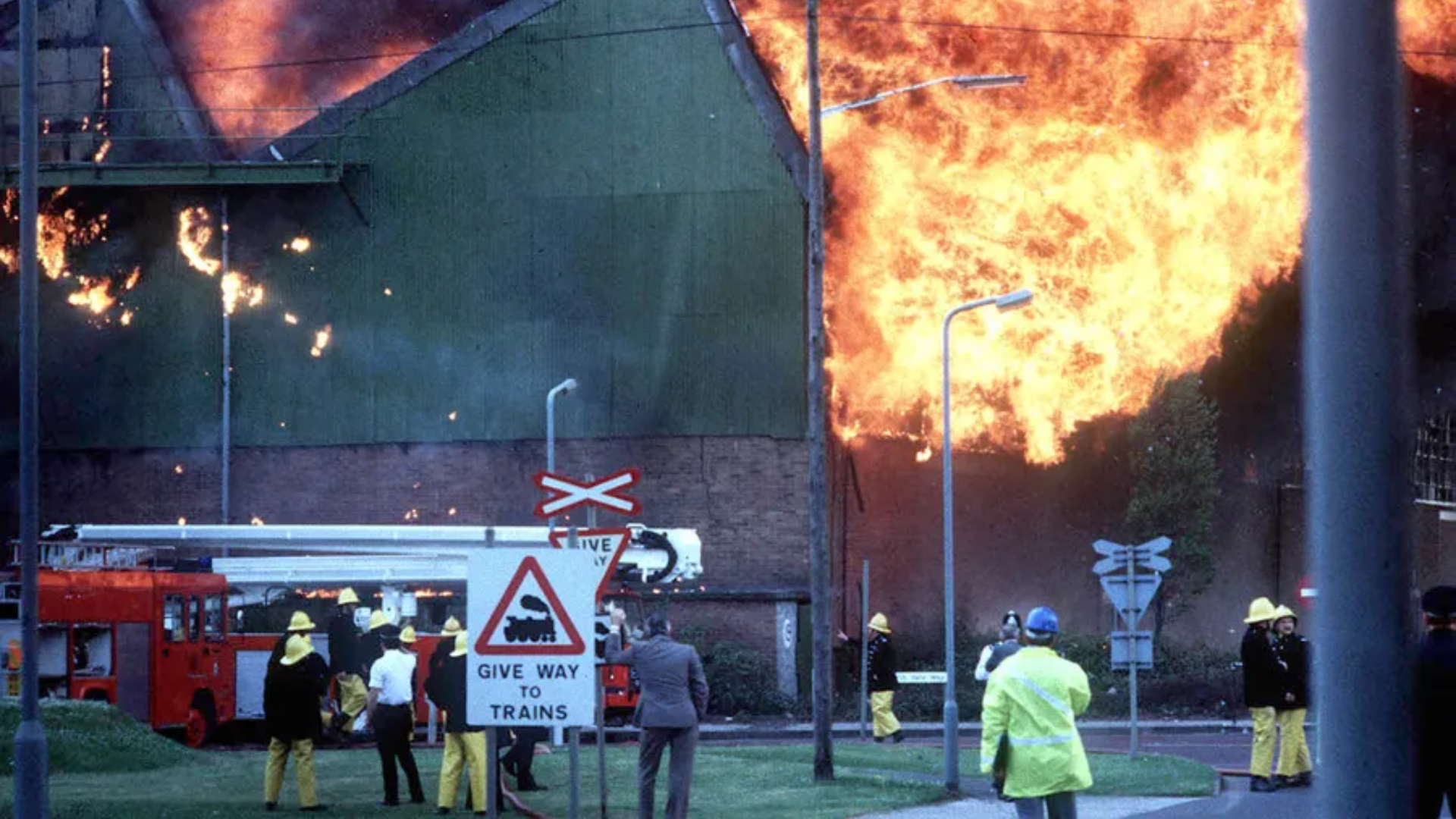
The Army Fire Service was involved in responding to major incidents alongside civilian brigades during this time, including two fires in 1983 and 1988 at the then Central Ordnance Depot, Donnington. The site was overseen at that time by the RAOC, and houses the Defence Fulfilment Centre which is an extensive Armed Forces supply store. The 1983 fire caused additional issues by scattering dust containing asbestos over a 15 square mile area.

Firefighters at the scene of the 1983 fire at MOD Donnington (Copyright 2018 The Shropshire Star).
Defence Fire and Rescue Service – 1991 – present
In 1991, the separate fire service branches of the Army, Royal Navy and Royal Air Force amalgamated to form the Ministry of Defence Fire Service. Despite this, the specialised nature of military activities led to the RAF and Fleet Air Arm of the Navy still maintaining their own dedicated firefighters. As of 2021, the Defence Fire and Rescue Service was in the process of being outsourced to Capita, a private contractor. Part of this outsourcing contract has included the delivery of 50 new vehicles to military sites around the country.
As well as protecting military installations in the UK, the DFRS may be deployed overseas to assist the Armed Forces in theatres of war or peacekeeping activities.
Read part two of George’s exploration of firefighting in the British Army here.
George Matthews, RLC Museum Volunteer
-

- A Bedford QL 3-ton truck, one of the tenders of 104 Fire Fighting Company (Army Fire Service), in Normandy in 1944 (IWM (B 8120)).
-
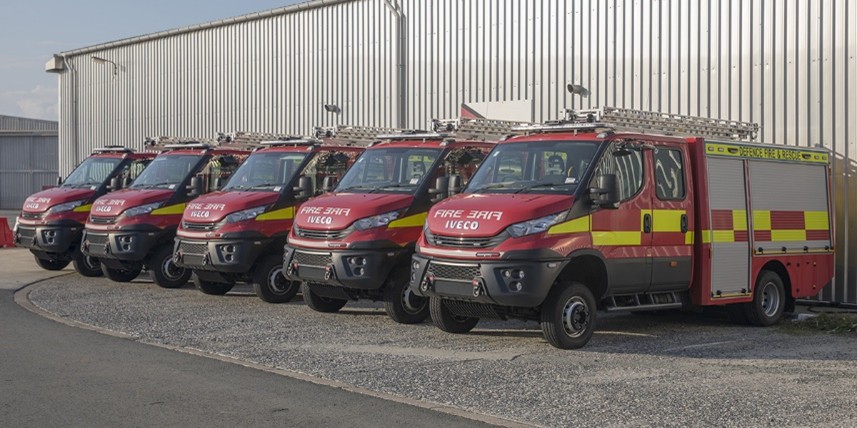
- DRFS Iveco fire trucks at RAF Akrotiri (Iveco Fire trucks 01 – Defence Fire and Rescue Service – Wikipedia by The joy of all things is licensed under CC BY 4.0)
-

- Army fire station at Bordon, built in 1906, with a horse drawn engine visible (Copyright 2025 Woolmer Forest Heritage Society)


wonderful story would love hear more thank you,👍